
Tax form guide · US · 2026
How to fill out Form 941
The Employer's Quarterly Federal Tax Return, line by line: what each line asks for, where the number comes from in your payroll, when it is due and what a late one costs.

Tax forms › Form 941 · Last reviewed October 25, 2026 · General information, not tax advice
Form 941 at a glance
| What it reports | Federal income tax withheld, Social Security and Medicare tax (employee and employer shares) for one quarter |
|---|---|
| Who files | Every employer that pays wages subject to withholding, until a final return is filed |
| How often | Quarterly |
| Next due dates | Q4 2026: Feb 1, 2027 · Q1 2027: Apr 30, 2027 · Q2: Aug 2 · Q3: Nov 1 |
| File with | IRS, by e-file or paper |
What Form 941 is
Form 941 is the quarterly return for the taxes that come out of paychecks: federal income tax withheld, the employee's Social Security and Medicare tax, and your matching employer share. It reconciles what you owed for the quarter with what you deposited.
The return does not carry the money. Most employers deposit the tax during the quarter, monthly or semiweekly, by electronic funds transfer. Form 941 then shows the total and how it was paid.
Who has to file
- Any business that pays wages to employees and withholds federal income tax, Social Security or Medicare. File for every quarter, even one with no payroll, until you file a final return.
- Very small employers the IRS has told in writing to file Form 944 file once a year instead. Without that notice, file 941s.
- Seasonal employers can tick the seasonal box on line 18 and skip quarters with no wages.
- Household and farm employers generally file Schedule H and Form 943 instead.
Due dates
| What | Due |
|---|---|
| Q4 2026 (October to December) | Mon, Feb 1, 2027 (Jan 31 is a Sunday); Wed, Feb 10 if every deposit was on time |
| Q1 2027 (January to March) | Fri, Apr 30, 2027; Mon, May 10 if deposits were on time |
| Q2 2027 (April to June) | Mon, Aug 2, 2027 (Jul 31 is a Saturday); Tue, Aug 10 |
| Q3 2027 (July to September) | Mon, Nov 1, 2027 (Oct 31 is a Sunday); Wed, Nov 10 |
The rule is the last day of the month after the quarter, moved to the next business day when it falls on a weekend or legal holiday. Deposits have their own, earlier schedule: monthly depositors by the 15th of the next month, semiweekly depositors by the Wednesday or Friday after payday.
Penalties for filing late or wrong
- Filing late: 5% of the unpaid tax for each month or part of a month the return is late, up to 25%.
- Paying late: 0.5% of the unpaid tax per month, up to 25%, plus interest.
- Depositing late: 2% if 1 to 5 days late, 5% if 6 to 15 days, 10% if 16 days or more, and 15% if still unpaid 10 days after an IRS notice.
- Trust fund recovery penalty: the people responsible for paying over withheld tax can be personally liable for 100% of the unpaid amount.
Form 941 line by line
| Line | What goes there | Where it comes from in your books |
|---|---|---|
| 1 | Number of employees paid for the pay period that includes the 12th of the quarter's last month (March 12, June 12, September 12, December 12) | Your payroll register for that pay period |
| 2 | Wages, tips and other compensation paid in the quarter: the federal income tax wages, the same basis as W-2 box 1 | Gross pay for paychecks dated in the quarter, less pre-tax deductions such as 401(k) deferrals and cafeteria-plan premiums |
| 3 | Federal income tax withheld | The federal withholding column of the quarter's paychecks |
| 4 | Tick only if no wages were subject to Social Security or Medicare | Rare; most employers leave it blank |
| 5a | Taxable Social Security wages, column 1; column 2 is × 0.124 | Gross pay less Section 125 deductions, stopping at $184,500 per employee for 2026 |
| 5b | Taxable Social Security tips, × 0.124 | Tips employees reported to you |
| 5c | Taxable Medicare wages and tips, × 0.029 | All Medicare wages; there is no wage cap |
| 5d | Wages and tips subject to Additional Medicare Tax withholding, × 0.009 | Each employee's wages above $200,000 for the year, from the point they cross it |
| 5e | Total Social Security and Medicare taxes (5a to 5d, column 2) | Should be close to the employee plus employer Social Security and Medicare on your paychecks |
| 5f | Tax due on unreported tips under a section 3121(q) notice | Only if the IRS sent you that notice |
| 6 | Total taxes before adjustments (lines 3 + 5e + 5f) | Calculated |
| 7 | Adjustment for fractions of cents | The small difference between line 5e and the tax actually withheld, usually a few cents |
| 8 and 9 | Adjustments for third-party sick pay, and for tips and group-term life insurance | Only if they apply |
| 10 | Total taxes after adjustments | Calculated |
| 11 | Qualified small business payroll tax credit for increasing research activities (Form 8974) | Only if you elected the credit on your income tax return |
| 12 | Total taxes after adjustments and credits | Calculated; this decides whether you can pay with the return (under $2,500) |
| 13 | Total deposits for the quarter, including any overpayment applied from the previous quarter | The EFTPS or IRS account payments you made for the quarter |
| 14 and 15 | Balance due, or overpayment (applied to the next return or refunded) | Calculated |
| 16 | Your deposit schedule and tax liability: monthly depositors enter each month's liability; semiweekly depositors attach Schedule B | The tax for paychecks by pay date, not by the date you deposited |
Parts 3 to 5 cover a closed or seasonal business, third-party designee, and the signature. The 2026 instructions also add an "Aggregate Return Filers Only" section for agents and certified PEOs.
Common mistakes
- Reporting wages by pay period end instead of pay date. A paycheck dated January 2 for December work belongs to Q1.
- Putting gross pay on line 2 when employees have 401(k) or other pre-tax deductions.
- Line 16 or Schedule B that does not add up to line 12. The IRS checks, and a mismatch can trigger an averaged failure-to-deposit penalty.
- Forgetting to stop Social Security at the $184,500 wage base for a high earner.
- Not filing a return for a quarter with no payroll before you have filed a final return.
- Four quarters that do not add up to the year's W-2s. The IRS and SSA compare 941 totals with W-3 totals.
How to file Form 941
- Close the quarter's payroll. Make sure every paycheck dated in the quarter is entered and any voids are recorded, then print a payroll summary for the quarter.
- Fill lines 1 to 12. Enter the employee count, wages, withholding and taxable Social Security and Medicare wages, and let the form calculate the taxes. Check line 5e against your paychecks' Social Security and Medicare totals.
- Enter deposits and the liability schedule. Enter what you deposited on line 13 and your monthly liabilities on line 16, or complete Schedule B if you are a semiweekly depositor.
- File the return. E-file through an IRS-authorized provider or tax software (see IRS.gov/EmploymentEfile), or mail the paper form to the address in the instructions for your state.
- Pay any balance. Pay a balance under $2,500 electronically with the return, or through EFTPS or your IRS business tax account. Larger amounts should already have been deposited.
How AcboBooks fills it in
In AcboBooks 0.2.1, Payroll → Payroll Tax Forms opens on Form 941. Pick the quarter and year and it totals the non-voided paychecks dated in that quarter.
- Wages, tips and other compensation: total gross pay for the quarter.
- Federal income tax withheld: the line 3 figure.
- Social Security tax: the employee and employer shares together (12.4%).
- Medicare tax: both shares together (2.9%).
- Total taxes, and an Excel/CSV export of the figures.
What it leaves to you
- The wages figure is gross pay. If employees have pre-tax deductions, reduce it to federal income tax wages for line 2 and use the right taxable wages on lines 5a and 5c.
- It does not fill line 1, 5d, 7, 13 or 16. Take the employee count from your payroll register, your deposits from your bank records, and the monthly liabilities from the paychecks' pay dates.
- AcboBooks prepares the figures; it does not file returns or make deposits for you. You file through the IRS or SSA and pay through EFTPS or your IRS business tax account.
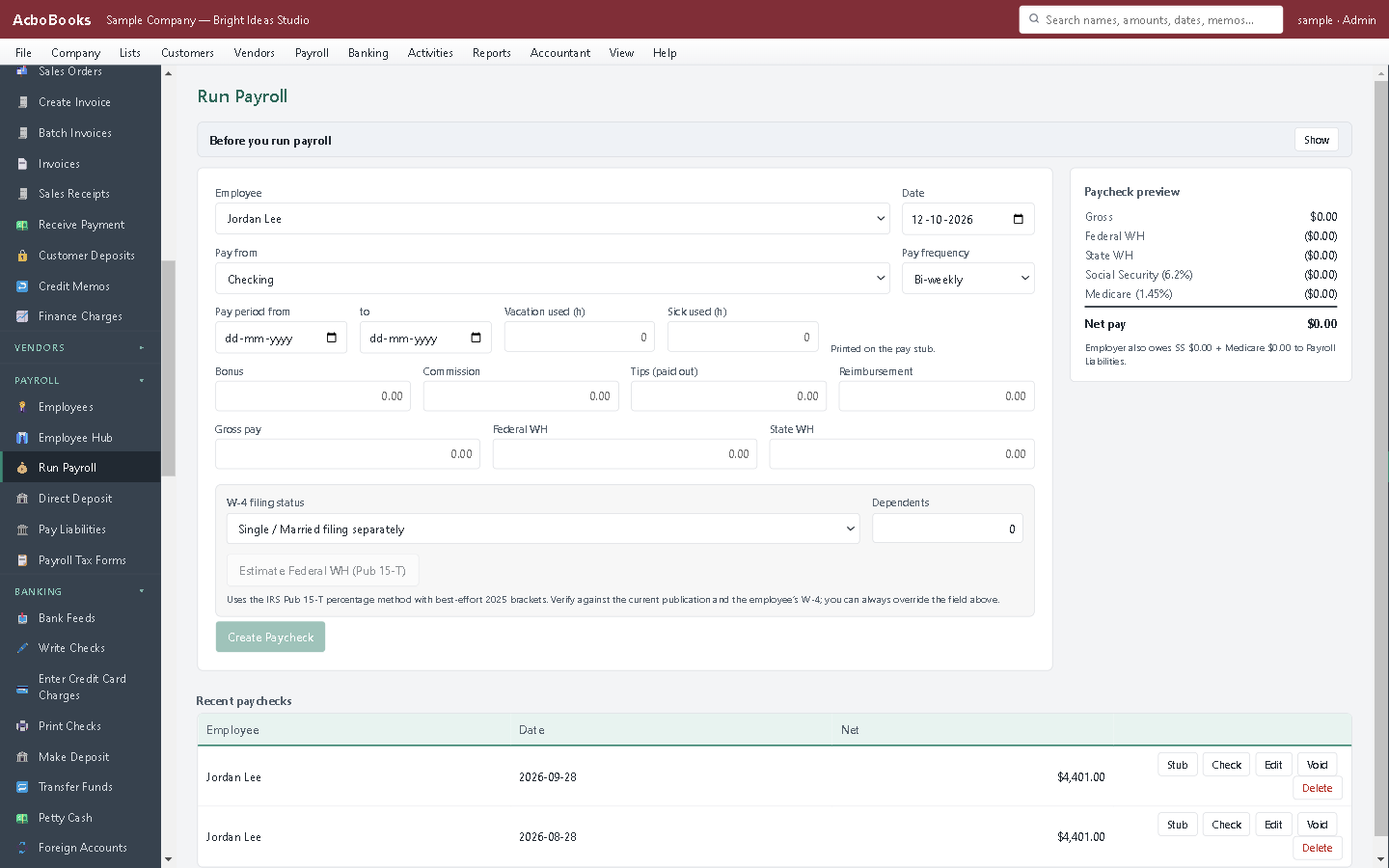
Described as of AcboBooks 0.2.1. See US payroll in AcboBooks
Questions
When is Form 941 due for the fourth quarter of 2026?
Monday, February 1, 2027, because January 31 is a Sunday. If you made every deposit for the quarter in full and on time, you have until Wednesday, February 10, 2027.
Do I file Form 941 if I had no payroll this quarter?
Yes, unless you have filed a final return or you are a seasonal employer who ticked the seasonal box. Report zero wages and file on time.
What is the difference between Form 941 and Form 940?
Form 941 is quarterly and covers federal income tax withheld plus Social Security and Medicare. Form 940 is annual and covers federal unemployment tax (FUTA), which only the employer pays.
Can I pay the tax with Form 941 instead of depositing it?
Only if line 12 is under $2,500 for the current quarter or the prior quarter and you did not trigger the $100,000 next-day deposit rule. Otherwise deposits are due during the quarter.
How do I fix a mistake on a Form 941 I already filed?
File Form 941-X for that quarter. Do not file a second Form 941.
Sources
- IRS Instructions for Form 941 (03/2026)
- IRS: About Form 941
- IRS Publication 15 (2026), Employer's Tax Guide
- IRS: Employment tax due dates
- IRS: Failure to file penalty
- IRS: Failure to pay penalty
- IRS: Failure to deposit penalty
Checked against these sources on . Dates assume a calendar year and apply the next-business-day rule for weekends and holidays.
Related
- How to fill out Form 940
- How to fill out Form W-2
- How to fill out Form W-3
- How to fill out Form W-4
- Form 941 vs Form 940
- 2027 US small business tax calendar
- How to run payroll in the US
- Payroll software for US small businesses
- The small-business payroll guide
- Paycheck calculator (US, 2026)
- All tax form guides
General information, not tax or legal advice. Forms, thresholds and dates change; confirm with the IRS and SSA or a tax professional before you file.
Get started
Year-end forms from the paychecks you already ran.
AcboBooks keeps payroll, contractors and your books in one file, so the 941, 940, W-2 and 1099 figures agree. Bought once, on your own PC.
No card. No account. Nothing to cancel.